“None of Them Can Find the Short.” 4 Owners Swapped Parts for Months. It Was Always a Wire.
A truck dead on the railroad tracks. Headlights gone at 50 mph. A dark camper with a semi on its bumper. Four owners swapped parts for months, then found the bad wire in minutes.
“has been to 4 mechanics now. None of them can find the short.”
A car owner asking for help on Reddit's r/MechanicAdvice · read the thread
Dramatization based on customer experiences. Individual results vary.
If you have ever typed something like that at 11 at night, with a third new relay in, the same dead tail light and a $180 diagnosis on the passenger seat, this page is for you.
Here is the part nobody at the parts counter says out loud: it was never the part. It was the wire between them.
A multimeter, a test light and a scan tool all answer one question: is this circuit bad? Not one of them tells you where along forty feet of wire the problem is hiding. So you buy the next part. And the shop bills you to guess too: "Labor starts at 180 just to look at it."
The four owners below did exactly that, for months. Then each of them clipped a little box onto the circuit, followed a chirping tone down the wire, and it went silent right on top of the fault. A truck that died on the railroad tracks. A nurse afraid of her own car. A daughter on a black county road with no headlights. A semi's air horn behind a dark camper.
If you have a problem that comes and goes, read these before you buy another part.
Four Mechanics, $1,413 in Parts and a $1,500 Quote. The Truck Died on the Railroad Tracks.
The fourth mechanic slid my keys back across the counter and said, "I'm not charging you. I can't find it."
That was the nicest thing anybody said to me in eleven weeks.
I'm 56. I drive a 2013 Silverado with 212,000 miles on it, and I've never paid somebody to do what I can do myself. But this truck beat me.
I'd be doing 45 and every gauge on the dash would drop dead to zero at the same time. Then the radio cut out. Then the engine stumbled. Three seconds later, everything came back like nothing happened.
The one that scared me was in July. My grandson Tyler was in the passenger seat. We were crossing the tracks on 49th Street when the dash went black and the engine died. Right on the rails.
I turned the key. Nothing. Then the crossing bells started ringing and the red lights started flashing over the hood.
On the third try it caught. I got us off the tracks with the gate arm coming down behind my tailgate. Tyler is nine. He didn't say one word the rest of the way home.
"We Think It's the Body Control Module. You're Looking at About Fifteen Hundred."
So I did what everybody does. I started buying parts. Battery, $219. Alternator, $389. Ignition switch, $164. Cables and a ground strap, $71.
Every part, the truck behaved for four or five days. Every time, the dash went black again.
Shop one plugged in a scanner, found "no codes," and charged me $129. Shop two replaced a relay I didn't ask for: $246. The dealer wanted a $195 diagnostic, then quoted me $1,500 for a body control module.
I asked if he was sure. "Not a hundred percent. But it's where we'd start." Where they'd start. With my $1,500.
Shop four was the guy who wouldn't charge me. "It's somewhere in the wiring. Could be a broken wire, could be a bad ground. I'd have to strip the whole interior to find it."
$1,413 spent. $1,500 more on a guess. My wife found the receipts in the glovebox. She just said, "Maybe it's time to trade it in."
Twelve Minutes. The Tone Stopped Under the Driver's Seat.
A week later an old man behind me at the parts store counter heard me telling the clerk about the dash. "Gauges drop out and come back? Bet you a dollar it's a wire rubbed through somewhere."
I told him four mechanics couldn't find it. He laughed. "They were testing parts. You need to follow the wire."
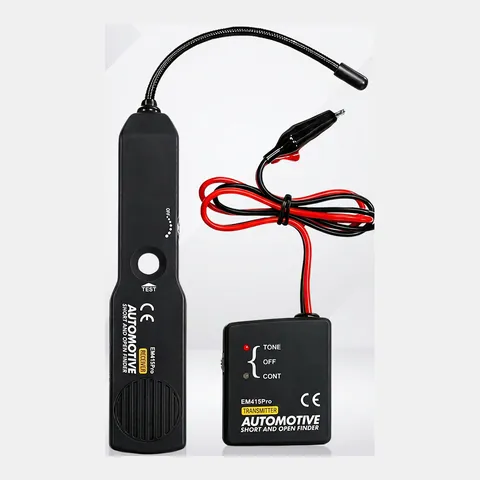
He opened a little case. A black box with two clips, and a wand with a bendy neck. "Clip this on one end. It sends a tone down the wire. Where the tone stops, that's your problem." A break, a short or a bad ground, he said, the tone quits right there. He called it TrueTrace.
I didn't believe him. A buddy's cheap tracer beeped on every wire in the bundle. But it was $39.99, less than shop one charged me to say "no codes."
Friday night I clipped the transmitter onto the instrument cluster feed at the fuse box. The wand chirped, steady, like a cricket. Up by the fuse box it chirped on everything, so I turned the sensitivity dial down. Then it only chirped on the one wire.
Down the kick panel. Along the rocker. Under the driver's seat. Chirp, chirp... silence. I backed up two inches. Chirp. Forward. Nothing.
Twelve minutes. I pulled the seat. The harness had been lying across the seat bracket for eleven years, and that steel edge had sawed through to a spot of bare copper the size of a grain of rice.
That was my $1,500 body control module. I cut out the bad inch, slid on one of the SolderStick solder seal connectors from my kit, hit it with the heat gun for about ten seconds and wrapped it in split loom. The repair cost about twenty cents.
That was nine weeks and 2,600 miles ago. Not one flicker. Last Sunday Tyler and I crossed those same tracks. He didn't even look up from his game.
Dramatization based on customer experiences. Individual results vary.
02Renee, 41 · ICU nurse · 2015 Honda Pilot
Dead at 4:52 Every Morning. $723 in Batteries and a Dealer Who "Couldn't Duplicate It."
At 4:52 in the morning, in my scrubs, in the dark, I turned the key and heard the click. Not even a crank. Third time that week.
I'm an ICU nurse, single mom of two, and my shift starts at 6, forty minutes away. The car would sit overnight and be dead in the morning. Not every morning. Just often enough that I never knew which one.
Three lates in a month is a write-up. I signed it, then sat in the parking garage and cried, holding that piece of paper.
The worst night was in March. Dead in a dark gas station lot, in sleet, at 9:40 at night, with my 14-year-old in the passenger seat and her phone at 3%. I waved down a stranger with jumper cables because I didn't have a choice.
I was afraid of my own car.
A New Battery, a Jump Pack, a Dealer and an "AGM, the Good Kind." Still Dead.
New battery, $189. Dead again in April. The store tested it: "It's fine. Probably your alternator." Also fine.
A $129 jump pack rode on the passenger seat like a pet. The dealer charged $180, kept it two days and said, "We couldn't duplicate the drain. You're probably looking at eleven hundred to start."
Another counter guy sold me an AGM battery, $225. $723 into a problem nobody could even find.
So every night at 10, after a twelve-hour shift, I was in my driveway with a headlamp and a 10mm wrench, unhooking my own battery. Every morning at 4:45, hooking it back up. My son called it "putting the car to bed."
The Chirp Stopped at the Spare Tire Well. I Lifted the Floor and Screamed.
A respiratory therapist at work who restores old Broncos put his coffee down. "That's a parasitic draw. Half the time it's a wire rubbed through, or mice chewed something and it's shorting to the body."
His method: pull fuses until the drain stops, then trace that circuit with a tone tracer until the tone dies. I told him I'm a nurse, not a mechanic. He laughed. "You start IVs on people who don't have veins. You can clip a lead and follow a beep."
I ordered the bundle that night: the tester plus 100 solder seal connectors, and their heat gun for $29.99 since I didn't own one.
Saturday, with him on FaceTime, the drain dropped on fuse 21, rear power accessories. I clipped the transmitter onto that circuit. Chirp. Chirp. Chirp. Under the carpet, past the second row, toward the cargo area.
At the spare tire well, the chirp stopped. Not faded. Stopped.
I lifted the cargo floor and screamed so loud my son came running. A mouse nest the size of a football. And running right through it, the wiring harness, chewed to bare copper in two places, touching the body of my car all night, every night.
"There's your eleven hundred dollar module," he said.
I cut out the chewed sections and sealed in two SolderStick connectors, ten seconds each. I timed it. Then I went to bed without the wrench for the first time in four months.
4:50 the next morning, it started. That was 37 mornings ago. It has started every single one.
Dramatization based on customer experiences. Individual results vary.
Why Four Shops Missed It: A Meter Is a Smoke Alarm With No Address
Two owners so far, a truck and an SUV. Two dealers, two quotes for a module, and both times the real problem was a wire.
That's not bad luck. It's how electrical diagnosis works. A multimeter, a test light and a scan tool are smoke alarms. They tell you there's a fire. They never tell you which room. The tool in these stories works the other way: it doesn't test. It follows.
Meanwhile the real fault is somewhere in 20 to 50 feet of harness. Rubbed through on a bracket. Chewed by a mouse. Pinched by a step. Green inside a splice. It only shorts when the cab flexes, the headlights are on, or the weather turns.
To find it, you don't need a better test. You need to follow the wire. Here's what happens when people don't.
Before You Buy One More Part: 5 Things Owners Ask
1
"It's probably the part. I'll try one more."
It almost never is. When a new fuse, relay or bulb doesn't fix it, the fault is in the wire or the ground between the parts. TrueTrace follows that wire and goes silent at the break, the short or the bad ground.
It finds opens, shorts and bad grounds. Clip on, follow the tone, and it stops where the circuit fails, whatever the cause.
4
"Good circuit testers cost a fortune. Cheap tracers beep on everything."
The kit with 100 solder seal connectors is $59.99, regularly $100 (tester alone $39.99). The beeping is a dial problem: turn the sensitivity down in a tight bundle and it picks out one wire. And the next part you guess at costs more than this tool. 30-day money-back if it doesn't find your fault.
5
"Can I use it on my car without frying something?"
It is built for DC systems from 6 to 42 volts: cars, trucks, trailers, RVs and boats. You clip the transmitter onto the dead or shorted wire you're tracing and follow the tone. No piercing, no cutting.
Twelve Fuses in Three Weeks, Never in Daylight. Then His Daughter Called: "Something's Burning."
My daughter called me from a pitch-black county road at 10:15 at night. "Dad. My headlights just went out. I can't see anything."
She was doing 50. Out where we live there are no streetlights. When your headlights go out at night, it's not dark. It's black. She steered by the feel of the gravel until she stopped. A deer crossed in front of her truck while she sat there.
The headlight fuse was blown. I put in a new one. Two nights later, it blew again. In three weeks I put eleven headlight fuses in that truck. I kept the dead ones in a cup holder.
It never blew during the day. Not once. The shop kept it a day: "Can't make it blow. Finding it means unwrapping the harness. $95 an hour, could be six hours, could be fifteen." He charged me $95 to tell me that.
The Dumbest Thing He Ever Did to a Vehicle: a 30 Amp Fuse in a 15 Amp Slot
Fuse twelve blew on a Tuesday. I was tired and mad, so I took out the 15 amp fuse and put in a 30. I figured a bigger fuse wouldn't blow.
It didn't. Two nights later Hailey called again, crying. "Dad, something's burning. There's smoke coming out from under the dash."
The wire off the headlight fuse had cooked. Insulation bubbled, melted and black. You could smell it fifty feet away.
The fuse was never the problem. The fuse was the only thing protecting her. And I took it away.
My brother-in-law, a lineman for thirty years, didn't laugh at me. I wish he had. "A fuse that keeps blowing is telling you something. A hot wire is touching metal. Clip a short finder in where the fuse goes and follow the tone." He keeps a TrueTrace in his truck.
Eight Minutes. The Tone Died at the Hood Latch Bracket.
I got the bundle, $59.99, because I already knew I'd be splicing something. First I cut out the cooked wire, spliced in fresh wire with two connectors and put the correct 15 amp fuse back for good.
Then I clipped the transmitter right into the fuse slot. Through the firewall. Along the inner fender. Across the radiator support. Chirp, chirp... silence.
Right where the harness crosses the hood latch bracket. Somebody, years ago, maybe me, had zip-tied it tight against the steel. A nick of bare copper, shiny as a new penny, and a little black scorch mark beside it.
Every bump at night with the headlights on, copper touched steel. Pop. Lights out. During the day, the headlights were off. Nothing to short.
The whole trace took eight minutes. New section of wire, a SolderStick connector on each end, a rubber grommet away from the bracket. Two months and forty-some night drives later, not one fuse.
Last Friday Hailey drove home from the late shift down that same county road. Headlights the whole way. She didn't call.
Dramatization based on customer experiences. Individual results vary.
04Linda, 64 · Retired school secretary · 31-foot travel trailer
A Semi's Air Horn Behind Her Dark Camper. At 64, She Found the Broken Wire Herself.
The semi's air horn went off so close behind our camper that I felt it in my teeth. Our trailer was completely dark back there. No running lights. No left signal. And I was the one driving.
When my husband Hal had a stroke, I learned to tow. I was proud of that. Until the night on I-75, just north of Chattanooga, when I signaled left and the semi behind me had no idea I was moving over.
Ten minutes later, blue lights. "Ma'am, your camper's completely dark back here. That's how people get killed on this stretch." A warning instead of a ticket, and no towing after dark until it was fixed.
New Bulbs, a Toothbrush, Test-Light Holes, a 3-Week Dealer Wait and a $400 Quote
LED bulbs, $38. Nothing. The 7-pin plug was green and fuzzy, so I scrubbed it with a toothbrush. Still nothing.
A $14 test light, stabbed into the wires like a video showed me. Every hole made Hal wince. "Now water gets in there."
Under the camper: tape, scotch locks, a nest of splices, and wires that disappeared into the frame channel where you can't see them.
The RV dealer: three weeks, $165 an hour, "could take a while." A mobile tech: $400 and ten days. That night Hal tried to talk me through it from his camp chair and got so frustrated he stopped talking.
Twenty-Six Feet of Trailer. Right Behind the Entry Steps, It Stopped.
Bev, 70, had the next site. Travels alone, tows with a Tacoma, fixes her own wiring. "I'm seventy and I travel by myself. I don't wait on anybody."
She showed me her TrueTrace. "Clip this box onto the wire at the plug. Walk the wand along the trailer. The tone stops where the wire's broken. You don't have to see the wire."
It was $39.99, less than a quarter of one hour at the dealer. I ordered the bundle with 100 solder seal connectors, $59.99, shipped to the campground.
I clipped onto the running light pin and walked the frame. Chirp, chirp, chirp. Past the propane tanks. Along the frame channel. Right behind the entry steps, it stopped.
I lay on my back in the gravel with a flashlight in my teeth. The step pivot had pinched the wire against the frame until it cut clean in half inside the insulation. From the outside it looked fine.
The left signal quit at one of the old scotch locks. The copper inside crumbled green in my fingers. I cut out both bad sections and sealed in SolderStick connectors while Hal held the flashlight with his left hand. Under an hour, including the coffee.
In September we pulled into West Yellowstone at dusk with every light on that camper glowing like a Christmas tree. Hal's picture of it is my lock screen now.
Dramatization based on customer experiences. Individual results vary.
How a Chirping Tone Finds a Fault You Can't See
Four different vehicles. Four faults hidden where no meter could point: under a seat, in a mouse nest, at a hood latch, behind camper steps. One method found all of them.
Step 1: clip the transmitter onto the circuit. At the fuse slot, the plug or the end of the wire. It sends a tone down the copper.
Step 2: sweep the receiver wand along the harness. It chirps as it picks up the tone right through the insulation, the loom, the tape and the trim. No piercing. No cutting.
Step 3: follow it until it goes silent. The tone dies right where the wire fails: the break, the short or the bad ground. You open that one spot instead of the whole dash.
The part cheap tracers get wrong is the bundle. Near a fuse box everything chirps. That's what the sensitivity dial is for: turn it down in a tight bundle and it picks out one wire; turn it up for a long run down a trailer.
The hardware is a two-piece EM415Pro automotive short and open finder, sold as SolderStick TrueTrace. It works on 6 to 42 volt DC systems: cars, trucks, trailers, RVs and boats.
Five Ways to Chase a Hidden Fault. Only One Points to the Spot.
Swap parts until it stops
What all four did first. In the stories above, Dale spent $1,413 and Renee $723. The fault was still there.
Shop visit
$100 to $300+ per visit, and four shops still couldn't find Dale's. Dealers start with the most expensive guess.
Test light, about $10
Tells you a wire is dead, not where. Every probe is another hole for water.
Multimeter, $20 to $80
Confirms the circuit is open or shorted. Then you start pulling panels.
✓ TrueTrace + 100 connectors, $59.99
Finds the fault and fixes it on the spot. It follows the wire through insulation and trim and goes silent at the fault; the connectors seal the repair. Every other option here only tells you something is wrong.
The Little Case All Four Keep in the Truck Now
SolderStick TrueTrace is a two-piece circuit fault finder: a clip-on transmitter and a receiver wand that follows its tone to the fault.
Pinpoints the exact fault, not just whether the circuit is bad
Reads through insulation, looms, panels and carpet: no piercing, no teardown
Adjustable sensitivity isolates one wire in a bundle
Shorts, opens, bad grounds and battery drains, 6 to 42 volts DC
Hard-shell storage case and quick-start tracing guide included
The bundle adds 100 SolderStick solder seal connectors, so you can fix the wire the minute you find it
“I am working on a Truck which had not ran in two years. I'm finding a lot of wires that were chewed through. I am using this to make repairs. I wished I would have had this product back when I was working.”
Find It and Fix It: Tester Plus 100 Connectors for $59.99
The tester alone is $39.99, regularly $60. It finds the fault.
The bundle is $59.99, regularly $100: the tester plus 100 SolderStick solder seal connectors. That's what Dale, Renee, Wes and Linda all used to make the repair on the spot. One heat gun pass seals the splice. For $20 more you're done the same afternoon.
No heat gun? Add one at checkout for $29.99. Shipping is free, and code FD50 applies itself at checkout, so there is nothing to type.
One shop visit is $100 to $300+. Dale's dealer quote was $1,500. The next part you guess at costs more than this tool.
How is this different from a multimeter or a test light?
Those tell you whether a circuit is bad. TrueTrace follows the wire and goes silent where it fails, so you know where to open.
Do I need to be an electrician?
No. Clip the transmitter on, sweep the wand, follow the beep. The quick-start card walks you through it.
Will it beep on every wire in a bundle?
Only if the sensitivity is set too high. Turn the dial down near the fuse box and it picks out one wire.
What vehicles does it work on?
Cars, trucks, trailers, RVs and boats with 6 to 42 volt DC systems. It isn't designed for live household AC.
My trailer harness runs inside a steel frame channel. Will it read through that?
Metal blocks the signal, so trace from the inside of the frame rail or panel where the wire runs. Linda did exactly that along 26 feet of trailer frame.
Are batteries included?
No. Pick them up before it arrives so you can use it on day one.
Why get the connector bundle?
Once the tone stops, you'll want to repair the wire right there. The 100 solder seal connectors solder and seal a splice in one heat gun pass.
What if it doesn't work for me?
You have 30 days. If it doesn't find your problem, send it back for your money.
The Fault Is Still in There. The Only Question Is How Much You Spend Guessing.
Dale spent $1,413 guessing. Renee spent $723 and four months with a wrench. Wes put eleven fuses and a 30 amp mistake into his daughter's truck. Linda waited on a dealer while a semi rode her bumper.
Every one of them found it in minutes once they followed the wire.
Picture this Saturday. Truck in the driveway, transmitter clipped on at the fuse box, wand in your hand. Chirp, chirp, chirp down the harness, and then nothing. You pull one panel instead of the whole dash, and the receipts in your glovebox stop growing.
If you've got a problem that comes and goes, don't buy another part tonight. Get the tool that tells you where.